
AC Capacitor Replacement in San Antonio: Warning Signs
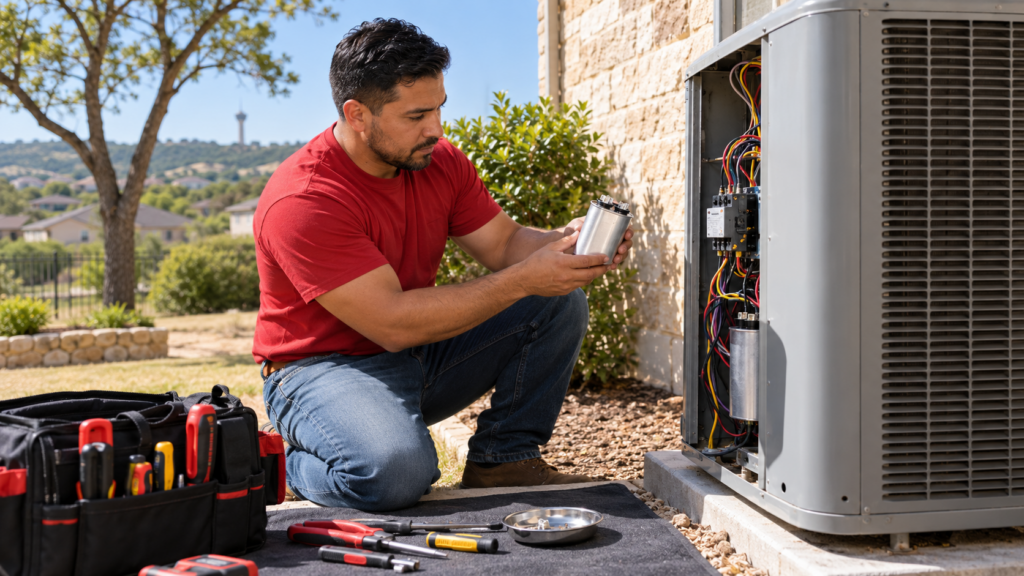
A failing AC capacitor can make a San Antonio home feel uncomfortable fast. Capacitors store and release electrical energy that helps the compressor and fan motors start and keep running. When one weakens, the outdoor unit may struggle to turn on—especially during a long stretch of Texas heat.
Common signs of a failing capacitor
- The outdoor unit hums but does not start
- The system starts slowly or needs several attempts
- The fan will not spin, or the AC blows warm air
- You hear repeated clicking at the outdoor unit
- The system turns off unexpectedly during a cooling cycle
Those symptoms can also come from wiring, a contactor, a motor, or another electrical component. That is why professional testing matters. A technician can safely measure the capacitor and inspect the rest of the starting circuit instead of replacing parts based on a guess.
Why capacitors fail in San Antonio heat
Capacitors work harder when an AC runs for long periods. Extreme outdoor temperatures, electrical stress, age, and vibration can shorten their useful life. A dirty condenser coil or restricted airflow can also make the system work harder, increasing the strain on electrical components.
Should you replace an AC capacitor yourself?
Capacitors can retain a dangerous electrical charge even after power is shut off. The correct microfarad rating, voltage rating, wiring connections, and safe discharge procedure all matter. For safety and to protect the equipment, we recommend calling an experienced technician for AC repair when a capacitor is suspected.
Preventing repeat AC starting problems
Routine HVAC maintenance helps identify worn electrical components, loose connections, dirty coils, and airflow problems before they cause a no-cool call. If your system has repeated start issues or is approaching the end of its useful life, we can explain practical repair and replacement options.
What an AC capacitor does
A capacitor stores electrical energy and releases it to help motors start and keep running smoothly. Most central air conditioners have a run capacitor for the compressor and the outdoor fan motor, often combined in a single dual capacitor. Some systems also have a start capacitor or a hard-start kit that gives the compressor an extra boost. When a capacitor weakens, motors struggle to start, run hotter, and draw more current. In San Antonio, capacitors are among the most common summer repairs.
How technicians test a capacitor
A capacitor can look normal and still be weak. Technicians test it with a meter that measures its capacitance in microfarads and compare the reading with the rating printed on the part. They also look for physical signs of failure, such as a swollen or domed top, oil leaking from the case, or burned terminals. Because capacitors hold an electrical charge even when the power is off, testing and replacement should be left to a professional. Many technicians also check the contactor and wiring at the same time, since those parts often wear together.
What else to check after a capacitor fails
A failed capacitor is sometimes the result of another problem. Excessive heat, a dirty condenser coil, a failing fan motor, voltage problems, or a worn contactor can all shorten capacitor life. A good repair visit checks those related parts so the new capacitor does not fail early. If the compressor has struggled to start for a long time, ask about the compressor’s condition as well; our guide on how heat affects your AC compressor explains why.
Hard-start kits and capacitors
Some systems benefit from a hard-start kit, which adds a start capacitor and relay to help the compressor start. Others benefit from a soft-start device that reduces the startup surge. Our guide to soft start vs. hard start kits compares the two. Your technician can recommend which, if either, makes sense for your equipment.
AC capacitor FAQs
How do I know if my AC capacitor is bad?
Common signs include a humming outdoor unit that will not start, a fan that does not spin, warm air from the vents, clicking at startup, or a system that shuts off unexpectedly. A technician can test the capacitor to confirm.
How long do AC capacitors last in San Antonio?
Capacitor life varies with heat, run time, and electrical conditions. San Antonio’s long, hot summers add stress, so capacitors are commonly checked during spring maintenance.
Can a bad capacitor damage my AC?
Yes. A weak capacitor makes motors and the compressor work harder to start and run, which can shorten their life. Replacing a failing capacitor early is a much smaller repair.
Is it safe to replace an AC capacitor myself?
It is not recommended. Capacitors can hold a dangerous electrical charge even with the power off, and the replacement must match the system’s specifications. Leave it to a qualified technician.
Service across the San Antonio area
HVAC Quality Solutions serves San Antonio, Bexar County, Helotes, Leon Valley, Shavano Park, Castle Hills, Boerne, and Fair Oaks Ranch. If your AC is humming, struggling to start, or not cooling well, contact our team for dependable service.