Indoor air quality is not only about what comes in from outdoors. It is also shaped by filtration, airflow, humidity, and how consistently a home’s HVAC system is maintained. In San Antonio, a few practical habits can help homeowners support cleaner, more comfortable indoor air.
Start with the filter
Use the correct filter size and replace it when dirty. A clogged filter can limit airflow and cause the equipment to work harder. Choose a filter appropriate for your system and household needs rather than using the most restrictive option without guidance.
Support airflow
Keep return grilles clear and supply vents open. Dust buildup, pet hair, and blocked returns can affect circulation. Regular HVAC maintenance also gives a professional an opportunity to review indoor equipment, drainage, and airflow.
When indoor air feels different
Persistent dust, musty smells, humidity concerns, or rooms that feel stale can point to issues worth discussing. A technician can help determine whether the concern relates to the cooling system, filtration, drainage, ductwork, or another source.
Local indoor air quality support
HVAC Quality Solutions serves San Antonio, Bexar County, Helotes, Leon Valley, Shavano Park, Castle Hills, Boerne, and Fair Oaks Ranch. For practical comfort guidance, contact our team.
Repair or replace? Start with the right questions.
Compare the condition of your system, the proposed work, and the complete price.
Draft for technical review
Start with the condition of your system.
Ask what failed, what the proposed repair addresses, and whether other known issues affect the decision. The age of the equipment is useful context, but a complete recommendation should also reflect its condition and service history.
Compare complete written proposals.
For a repair, ask about the exact work and its price. For a replacement, compare the equipment, capacity, installation requirements, included protection, and warranty terms. A large advertised discount does not tell you the final installed price.
Ask about the details.
HVAC Quality Solutions includes float-switch installation with a new or replacement system. Ask what else is included in your specific estimate and which site conditions could require separately priced work.
Get a second opinion.
If you have an existing written replacement recommendation, contact our team to discuss a second opinion. A free estimate gives you another opportunity to understand your options before making a decision.
Meet the small safety device we include with new and replacement systems.
Draft for technical review
A small switch with a specific job.
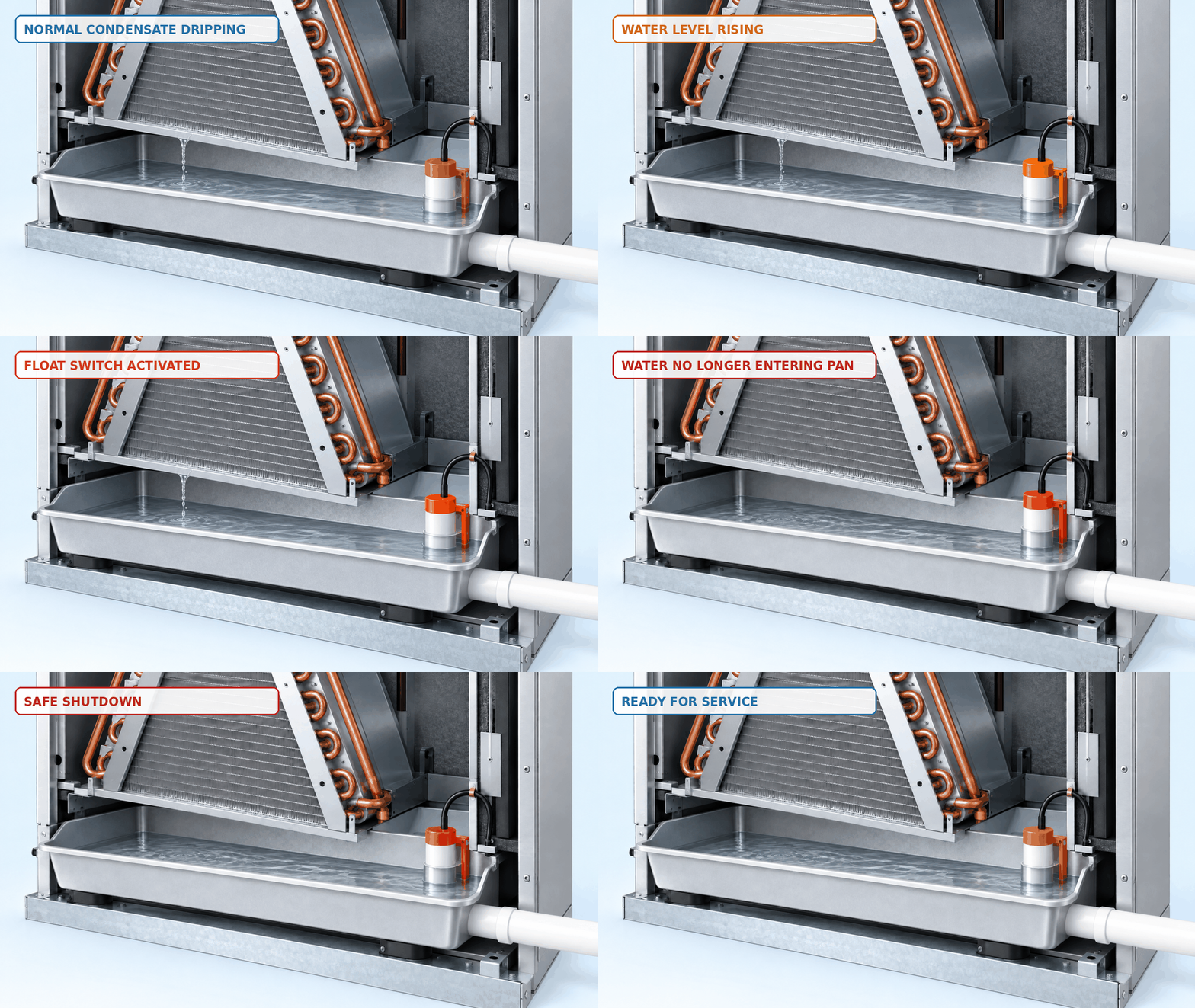
Your AC produces condensate as it cools. If water backs up at the float switch’s location, the float rises and the switch can interrupt cooling. That gives you a reason to have the drainage problem checked instead of allowing the system to continue producing water unchecked.
What HVAC Quality Solutions includes.
Float-switch installation and testing are included with a new or replacement system at no added charge. The switch configuration is selected for the installation and explained in your written scope.
Understand the limits.
A float switch helps reduce overflow risk at the point it monitors. It does not catch every possible leak, and it does not replace regular drain maintenance. If the switch stops your system, ask a qualified technician to identify the cause. Do not bypass the safety device.
Compare what is included.
When comparing installation proposals, check the equipment, included work, safety devices, written warranty terms, and who to contact for support. A complete quote helps you understand the value behind the final price.
A practical starting point for planning your next maintenance visit.
Draft for technical review
Plan the visit before you need it urgently.
Discuss seasonal maintenance with our team before the weather brings heavier cooling demand. Share any changes you have noticed, including weak airflow, unusual sounds, or trouble keeping the home comfortable.
Ask what the visit includes.
A maintenance checklist helps you understand the work. Clarify which checks and routine cleaning are included, and ask about separate charges for repairs or deep cleaning before authorizing them.
Keep a useful service record.
Save the written findings and note any follow-up recommendations. Having your equipment information and service history available makes the next conversation easier.
Understand the limits of a tune-up.
A maintenance visit supports system care and can reveal problems. It cannot guarantee that equipment will never break down. If something changes after the visit, contact our team and describe what you are noticing.
Regular HVAC maintenance is one of the most practical ways to keep a home comfort system dependable. In San Antonio, where air conditioners run for much of the year and heating systems may sit idle until a cold front arrives, the question is often not whether to schedule maintenance, but how often.
Annual and twice-yearly HVAC maintenance plans are two different scheduling options, not two names for the same plan. Here is how they compare.
What annual maintenance looks like
With annual HVAC maintenance, you plan one visit each year with an agreed scope for your home and equipment. Many homeowners schedule it in spring, before the cooling season, since the air conditioner carries the heaviest load in South Texas. One visit gives you a yearly review of the equipment and a service record you can refer back to when planning future work.
Keep in mind that one visit does not have the same scope as separate cooling and heating visits. If the appointment focuses on cooling, the heating side may get less attention.
What twice-yearly maintenance looks like
Twice-yearly maintenance means two planned visits a year: one focused on cooling and one focused on heating. A spring visit prepares the AC for summer, and a fall visit checks the furnace or heat pump before the first cold snap. This schedule makes sense when you want seasonal findings rather than trying to cover every concern in a single appointment.
Which homes benefit from two visits?
Homes with heat pumps, since the same equipment works in both seasons
Homes with gas furnaces, where a heating-season safety check is valuable
Older systems that you want to watch more closely
Homes with pets, allergies, or heavy dust, where filters and coils load faster
Homeowners who want a clearer service history before deciding on repair or replacement
Questions to ask before choosing an HVAC maintenance plan
Before enrolling in any maintenance arrangement, ask for the details in writing:
Which systems and how many pieces of equipment are included?
What is on the checklist for each visit?
When will the visits take place?
Are repairs, parts, or deeper cleaning included, or quoted separately?
What are the price and cancellation terms?
Repairs are typically separate unless your written agreement specifically includes them. Knowing that upfront avoids confusion later.
Make the most of every visit
Share any comfort concerns before the appointment, such as rooms that run warm, unusual noises, or higher utility bills. Keep your filter on a regular replacement schedule between visits, and ask the technician to explain findings and any recommended next steps so you can plan ahead.
Signs your system needs attention sooner
Even with a plan in place, some changes are worth a call before the next scheduled visit:
The system runs longer than usual or struggles to reach the set temperature.
Airflow feels weaker in some rooms.
You notice new noises, odors, or water near the indoor unit.
Utility bills rise without a change in how you use the system.
Ice forms on the refrigerant lines or indoor coil.
Catching these signs early often keeps a small issue from becoming a larger repair. Keep notes on what you notice so the technician can compare them with findings from earlier visits. If you are not sure whether a change is serious, a quick call can help you decide whether it can wait for the next visit.
Maintenance and equipment life
Regular maintenance cannot make old equipment new, but it helps a system run under less strain. Clean coils, clear drains, tight electrical connections, and correct airflow all reduce stress on motors and compressors. Over time, consistent service records also make it easier to decide when a repair still makes sense and when it is time to plan for replacement.
HVAC maintenance plan FAQs
How often should HVAC be serviced in San Antonio?
Many homeowners schedule at least one visit a year before the cooling season. Homes with heat pumps or gas furnaces often benefit from a second visit in fall, so the heating side gets its own check.
Are repairs included in an HVAC maintenance plan?
Usually not, unless your written agreement specifically includes them. Repairs and deeper cleaning are typically quoted separately so you can review and approve them first.
What does an HVAC maintenance visit check?
The checklist is agreed before enrollment and depends on your equipment, but it commonly covers filters, coils, drainage, electrical components, airflow, and controls. Coils with heavy buildup can be addressed with AC coil cleaning.
When is the best time to schedule HVAC maintenance in San Antonio?
Spring, before the first long stretch of heat, is the most common time for a cooling visit, since it is easier to schedule before peak demand. Fall is a good time to check heating equipment before the first cold front.
HVAC maintenance across the San Antonio area
HVAC Quality Solutions provides HVAC maintenance for San Antonio and Bexar County, including Helotes, Leon Valley, Shavano Park, Castle Hills, Boerne, and Fair Oaks Ranch. To compare annual and twice-yearly options for your home, contact our team or call or text (830) 765-2048.
Soft-start and hard-start kits both address AC starting performance, but they do different jobs. Choosing the right one depends on the system, the electrical symptoms, and the homeowner’s goal—not simply on which add-on sounds stronger.
What a hard-start kit does
A hard-start kit gives the compressor an added boost at startup. It may be considered when a compressor has difficulty starting and a technician confirms the system can benefit from it. It is not a universal cure for an aging compressor, low voltage, a failing capacitor, or other electrical faults.
What a soft-start kit does
A soft-start device manages the compressor’s startup demand more gradually. It can reduce the brief inrush of current when the system starts. This may be useful for homeowners concerned about generator compatibility, limited electrical capacity, or smoother starts. It does not replace needed repairs or routine maintenance.
Which one do we recommend?
We recommend a professional diagnosis first. For a specific start-up problem, a correctly selected hard-start kit may be appropriate. For reducing startup demand and supporting certain power-management goals, a soft-start may be the better fit. The right recommendation starts with electrical testing, equipment age, compressor condition, and the home’s power setup.
Our AC repair team can inspect capacitors, contactors, wiring, voltage, and compressor operation before recommending an accessory. Regular HVAC maintenance also helps catch small electrical issues early.
Serving San Antonio and nearby communities
HVAC Quality Solutions serves San Antonio, Bexar County, Helotes, Leon Valley, Shavano Park, Castle Hills, Boerne, and Fair Oaks Ranch. Contact our team for a clear, equipment-specific recommendation.
A failing AC capacitor can make a San Antonio home feel uncomfortable fast. Capacitors store and release electrical energy that helps the compressor and fan motors start and keep running. When one weakens, the outdoor unit may struggle to turn on—especially during a long stretch of Texas heat.
Common signs of a failing capacitor
The outdoor unit hums but does not start
The system starts slowly or needs several attempts
The fan will not spin, or the AC blows warm air
You hear repeated clicking at the outdoor unit
The system turns off unexpectedly during a cooling cycle
Those symptoms can also come from wiring, a contactor, a motor, or another electrical component. That is why professional testing matters. A technician can safely measure the capacitor and inspect the rest of the starting circuit instead of replacing parts based on a guess.
Why capacitors fail in San Antonio heat
Capacitors work harder when an AC runs for long periods. Extreme outdoor temperatures, electrical stress, age, and vibration can shorten their useful life. A dirty condenser coil or restricted airflow can also make the system work harder, increasing the strain on electrical components.
Should you replace an AC capacitor yourself?
Capacitors can retain a dangerous electrical charge even after power is shut off. The correct microfarad rating, voltage rating, wiring connections, and safe discharge procedure all matter. For safety and to protect the equipment, we recommend calling an experienced technician for AC repair when a capacitor is suspected.
Preventing repeat AC starting problems
Routine HVAC maintenance helps identify worn electrical components, loose connections, dirty coils, and airflow problems before they cause a no-cool call. If your system has repeated start issues or is approaching the end of its useful life, we can explain practical repair and replacement options.
Service across the San Antonio area
HVAC Quality Solutions serves San Antonio, Bexar County, Helotes, Leon Valley, Shavano Park, Castle Hills, Boerne, and Fair Oaks Ranch. If your AC is humming, struggling to start, or not cooling well, contact our team for dependable service.
When a San Antonio summer afternoon pushes your air conditioner for hours at a time, the compressor is doing the hardest work in the system. This sealed component moves refrigerant so your home can release heat outdoors. If it struggles, the whole system can lose cooling, run longer, or stop altogether.
Why extreme heat is hard on a compressor
Every AC system is designed to operate in warm weather, but long stretches of high outdoor temperatures raise the pressure and workload inside the refrigeration cycle. A dirty outdoor coil, restricted airflow, weak capacitor, low refrigerant charge, electrical issue, or an aging unit can make that workload even heavier. The compressor may overheat or cycle off on safety controls, leaving your home warmer than expected.
In South Texas, a thermostat set very low cannot force a tired system to cool faster. It can simply keep it running longer. Keeping doors and blinds closed during peak sun, replacing a clogged filter, and keeping the condenser clear of leaves and grass can reduce unnecessary strain.
Signs it is time to call for AC repair
Warm air or noticeably weaker cooling from the vents
A humming, clicking, or hard-start sound at the outdoor unit
Frequent breaker trips or repeated short cycling
Ice on refrigerant lines or water around the indoor equipment
Energy bills that rise while comfort falls
These symptoms can have several causes, so a professional diagnosis matters. Continuing to run a system that is overheating can turn a smaller repair into a larger one. Our AC repair team can check electrical components, airflow, coils, refrigerant performance, and compressor operation before recommending the right next step.
Protect your system before the next heat wave
Seasonal service is one of the simplest ways to spot issues before peak demand. A thorough HVAC maintenance visit helps identify dirty coils, loose electrical connections, drainage concerns, and worn parts that can affect cooling performance. If your system is older and repairs are becoming frequent, we can also help you weigh repair versus replacement without pressure.
Serving San Antonio and nearby communities
HVAC Quality Solutions serves homeowners in San Antonio, Bexar County, Helotes, Leon Valley, Shavano Park, Castle Hills, Boerne, and Fair Oaks Ranch. If your AC is struggling in the heat, contact our team to schedule service and restore dependable comfort.
An air conditioner will always make some sound, but a new rattle, squeal, grinding noise, or hard start deserves attention. San Antonio homeowners depend on their heating and cooling equipment through changing weather, and a clear response can help protect comfort and avoid needless strain.
Start with the basics
Check the thermostat setting, replace a visibly dirty filter, and make sure supply vents and return grilles are open. Keep the outdoor equipment clear of leaves, grass, and stored items. These safe homeowner steps support airflow, but they do not replace a professional diagnosis when performance has changed.
Know when to call
New noises, uneven temperatures, short cycling, weak airflow, water where it should not be, or a system that will not keep up are all reasons to schedule AC repair. A trained technician can test the equipment, explain the findings, and help you decide on the appropriate next step.
Protect year-round comfort
Routine HVAC maintenance helps identify many developing concerns before the hottest or coldest days make them more disruptive. It is also a good time to review filter habits, drainage, thermostat settings, and airflow.
Local HVAC help
HVAC Quality Solutions serves San Antonio, Bexar County, Helotes, Leon Valley, Shavano Park, Castle Hills, Boerne, and Fair Oaks Ranch. For helpful service and straightforward answers, contact our team.
A spring AC tune-up is one of the best ways San Antonio homeowners can prepare for the heat before the first long stretch of hot weather arrives. Your air conditioner may seem fine during a mild afternoon, then struggle when temperatures climb and it runs for hours at a time. A planned check gives you time to address small problems before comfort becomes urgent.
What a professional tune-up reviews
During a seasonal visit, a technician can inspect system performance, electrical connections, outdoor equipment, indoor airflow, thermostat operation, and condensate drainage. They can also look for worn components, debris near the condenser, or signs that the system is working harder than it should. This is practical preventive care, not a promise that no repair will ever be needed.
Simple homeowner steps
Replace a dirty air filter, keep supply vents and return grilles open, and clear leaves or stored items from around the outdoor unit. Do not remove panels or use harsh pressure on coils. Good airflow helps the equipment cool more evenly and may reduce unnecessary strain.
When to schedule sooner
Do not wait for summer if the AC is already loud, runs constantly, leaves rooms unevenly cooled, or produces weak airflow. Those are good reasons to arrange AC repair before the system is under its heaviest demand. A timely service visit can help you make an informed decision rather than reacting during a heat wave.
Spring cooling care across the area
HVAC Quality Solutions serves San Antonio, Bexar County, Helotes, Leon Valley, Shavano Park, Castle Hills, Boerne, and Fair Oaks Ranch. Schedule HVAC maintenance or contact our team to get your cooling system ready for the season.